

DCW Monthly: October 2026
This month’s content follows a standby LC past issuance and asks a practical question: once the instrument is out
This month’s content follows a standby LC past issuance and asks a practical question: once the instrument is out

Grappling with a high degree of concern over increasing fragmentation across the digital trade landscape, the ICC Digital Standards Initiative

Four draft opinions, two of which dealing with insurance documents and war risk exclusion wording, will be discussed in the


Kim Sindberg, Expert Product Manager at Nordea in Denmark and an ICC Banking Commission technical advisor, has never backed away from new opportunities and challenges. Having first worked in the transport industry, he stepped out to see documentary credits in a new light and became a banker. Since then, he’s applied his energy and enthusiasm to the constantly-evolving field of trade finance and its long-term vitality.
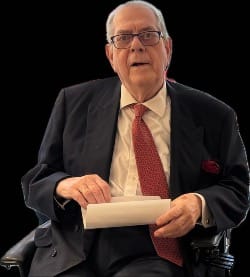
My background is from the transport industry, and I had customers using export documentary credits. A part of my job was to prepare bills of lading (and often even invoices, packing lists and certificates of origin) to be presented under credits. Of course, in the beginning I did a lousy job, as I had no clue what I was doing. I therefore signed up for a documentary credit seminar where the main speaker was Reinhard Längerich (pictured below) who reviewed the UCP 500 article-by–article with us. After that I thought: I want to do that – and I want his job! I guess it was the combination of trade, which has never stopped to fascinate me, and those very detailed rules that really intrigued me. In any case, that seminar made me realize that this is what I want to work with.
Shortly thereafter there was an opportunity to join the Trade Finance department in Unibank. I knew that job was mine – and so it was. I got to work with Reinhard who became my mentor and friend and when he retired, I took over his role as documentary credit expert.
There is no doubt it is “compliance” – meaning the controls required by the banks to prevent financial crime (e.g., sanctions violations and money laundering) has fundamentally – changed the industry and my role within it. When I started in the industry there were literally no structured controls to target financial crime. You were expected to “use your nose” and “common sense” to find out if something was off or wrong.
Today of course, banks generally have comprehensive frameworks in place for this. The issue with this is that it is driven by regulation, hence it generally has the highest priority. Higher than product (rules) knowledge and training. When I started in the business, I spent 100% of my time working with the rules and the transactions (including advice and training). These days, I spend more that 80% of my time working with issues relating to financial crime prevention.
Somehow it really is the rules and how they evolve that keep me engaged. However, I also owe many thanks to those who “lit my fire” when I started in the business. It seems that the flame was lit so bright that it is my guide even today. Needless to say Reinhard Längerich – but I also owe huge thanks to IIBLP. The late Professor James E. Byrne and Vincent M. Maulella embraced me with expertise, knowledge, and kindness that helped me evolve and take the necessary steps in the beginning of my career.
Today, I get a lot of energy and engagement from my work within the ICC and cooperating with my fellow ICC Technical Advisors led by David Meynell. It reminds me that no matter how long you have worked in this business there are still new things to learn and new angles to consider.
Last, but surely not least, my ongoing co-operation and friendship with ATM Nesarul Hoque is a driving force for me. I think that together (driven by Nesarul) we have given the market books – and thereby knowledge – that would otherwise not be available in compressed and structured form (and thanks to IIBLP for publishing those).
Those are main drivers and “engagers”!
I think that the suite of trade finance instruments, i.e., the documentary credit, collections, and guarantees offer a unique framework for risk mitigation and transaction management. I cannot think of any other “trade instrument” that does it better. However, these instruments are born in another time, that was “analogue”. At that time no one knew about electronic trade or for that matter “regulatory financial crime controls”. I think that those two, “electronic trade” and “regulatory financial crime controls”, are the biggest struggles today:
1) How to effectively “transform” a paper document-based instrument into an electronic instrument without losing significant features?
2) How to effectively, and with a satisfactory quality, perform the necessary financial crime controls on paper documents (sometimes consisting of hundreds of pages), when information is available banks to consider.
Naturally, those are in fact two sides of the same coin because in many ways the “solution” must be the same, meaning that new electronic developments must also consider and include financial crime controls.
One such moment, would of course be my first meeting with Reinhard which I have described in the opening.
However, one thing that really comes to mind is actually covid-19 and the implications of that from a trade finance perspective. Of course, covid-19 had an impact on everybody’s lives but the way it impacted trade finance was really an eye-opener for me. In some strange way, the rules changed from being “academic” to be the decisive factor on whether trade would work or not. During that time the UCP 600 was really challenged, as the situation opened so many actual issues that previously were discussed only in academic fora. This allowed me a whole new way to view and understand the rules, where they worked, and where there were actual gaps. During that time, I even published a book trying to capture the Trade Finance issues that were relevant (“CoronAdvice – covid-19 from a Trade Finance perspective” [2020]). The book is available on online bookshops such as Amazon.
This is a hugely interesting question. To say it short: To be available for guidance and training – but not stand in the way for younger people who comes with a different approach.
As mentioned earlier, the struggle to transform paper documents into an electronic format – and to evaluate that data based on the UCP rules (or something similar) has been going on through most of my life – and surely all of my work-life, and no doubt my generation has failed to effectively solve it at this point. I hope – and believe – that the next generation will have a better success rate.
To quote Twin Peaks: There is always music in the air! I love music and try to listen to music as much as possible – also “new” music – and many genres. Recently I have come across Rome (actual name is Jerome Reuter – a Luxembourgish singer) and am particular fond of his album “The Tower”. Especially the song “The Baron” has been a lot in my earphones during the last couple of months.

Gain full access to analysis, cases, eBooks and more with a DCW Free Trial