

DCW Monthly: November 2026
The ICC Banking Commission met in London from 9 to 11 November and finalized four Opinions. TA965 and TA968 both
The ICC Banking Commission met in London from 9 to 11 November and finalized four Opinions. TA965 and TA968 both

The ICC Banking Commission Meeting returned to London on 9-11 November 2026 with its first day designated for conferencing of working group members, working group updates, and its quarterly technical advisory session, including discussion of ICC Opinions.

On 4 November 2026, ICC announced availability of its 2026 Global Trade Intelligence Report. Formerly known as the ICC Trade

The ICC Banking Commission met in London from 9 to 11 November and finalized four Opinions. TA965 and TA968 both concern war risk cover and reach opposite results on discrepancy, while TA966 confirms that a confirming bank may advise a credit directly despite a Field 57A routing instruction. Separately, the ICC Steering Committee has backed a fast-track request to remove the HS Code and Incoterms fields Swift added in SR 2026.
Edward Stoltenberg and Byron McKinney put three public AI models up against the name-matching software banks use for sanctions screening and share the results. Saibo Jin begins a review of how China’s Supreme People’s Court handles permanent injunctions of independent guarantees, and Sandeep Roy opens a series asking whether supply chain finance is replacing traditional trade finance.
Plus: the executive summary from the Americas Standby & Guarantee Forum, CR Construction v. Barclays on a performance bond demand, and notes from a financial crime compliance event stacked with trade finance experts.
Here’s everything that’s new:
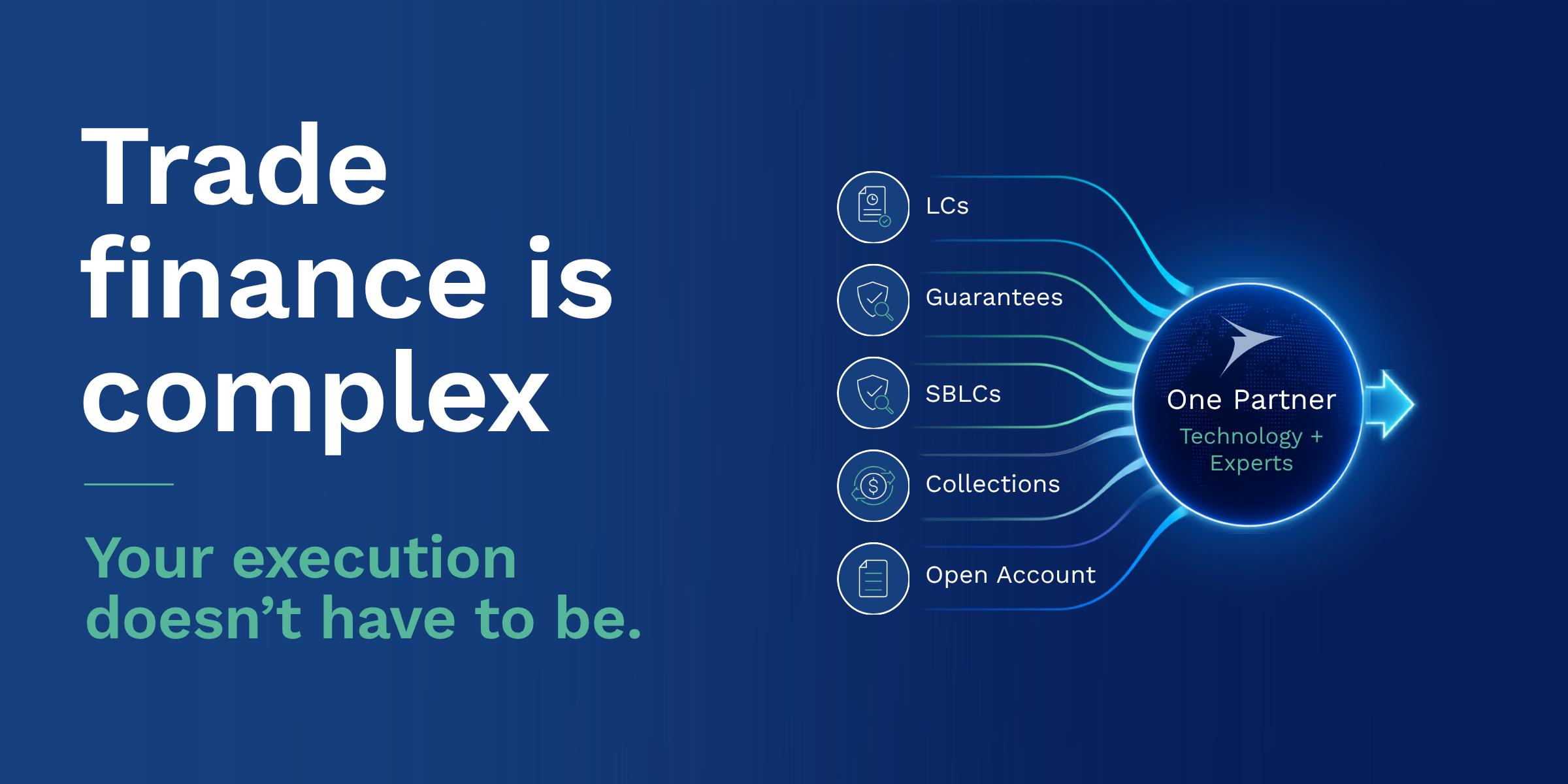
For banks and corporates, transformation shouldn’t mean replacing one set of complexities with another.
Trade Technologies brings technology, connectivity, and trade expertise together to make execution seamless, while keeping you in control.
Edward R. Stoltenberg and Byron McKinney ran 1,348 names, vessels and IMO numbers through three publicly available AI models and through the conventional name-matching software most banks rely on for sanctions screening. Loosening that software’s match threshold from 70% to 50% took false positives from 1 to 183. The AI models did better at clearing false positives, yet one described its own results as “highly accurate” while scoring worse on accuracy, precision and recall. The authors also consider what controls public models would need before a bank could rely on them.
By Edward R. Stoltenberg and Byron McKinney
In the first of two parts, Saibo Jin works through four of eight legal principles the Supreme People’s Court applies when asked to permanently enjoin payment under an independent guarantee. He draws on the 2016 PRC Independent Guarantee Provisions and cases including ANZ Bank, Manila Branch v. China National Electric Engineering Co., where the Court applied the Provisions to an ISP98 standby. He also addresses counter-guarantees and payment made in good faith.
By Saibo Jin
Discrepancy rates on first presentation have sat between 65% and 80% for years, and corporates with established trading relationships have little patience for a mechanism built to protect parties who do not know each other. Sandeep Roy asks whether supply chain finance is taking its place, and what the answer means for banks that do both. This is the first of two parts; the second turns to technology and tokenization.
By Sandeep Roy
The applicant sought to restrain Barclays from honoring a GBP 2.48 million demand under a GBP 11.7 million performance bond, arguing the demand did not come from the beneficiary, though it alleged no fraud and sought no relief against the beneficiary itself. The English court dismissed the application. The digest also looks at the bond’s conclusive evidence clause and at a counter-guarantee that outlived the bond by a month.
Banker's Takeaway offered by Glenn Ransier.
IIBLP held its 20th Americas Standby & Guarantee Forum in New York on 27 October. The executive summary covers risk weighting, the staggering dollar figures of the standbys behind data center financing and bank-fronted surety. Two auto-extension rulings, Illinois DNR v. Regions Bank and Starr Indemnity v. Midwest Mortgage, get close attention, and the corporates got their say on the increasing complexity of sanctions and export control documentation.
Janis Penton, Lecturer in Law at USC Gould School of Law, was the youngest lawyer at her firm in the early 1980s when she was handed a standby LC problem no one else there knew how to solve. With Boris Kozolchyk’s help she designed an approach the rating agencies later used as their template. She served as secretary of the lawyer-banker task force whose work became the blueprint for revising UCP and UCC and for creating ISP98, and was the first woman to chair the ABA’s LC Subcommittee.
Thanks for reading. Saibo Jin and Sandeep Roy both return next month with the second parts of their series, and we close out the year with more expert commentary.
Paid members have full access to articles, case summaries, practical eBooks, editorial analysis, and CPD credit.
Email us to find the right subscription for you.
Gain full access to analysis, cases, eBooks and more with a DCW Free Trial