

DCW Monthly: March 2026
This month’s content highlights a familiar reality in letter of credit law & practice: structure alone does not guarantee
This month’s content highlights a familiar reality in letter of credit law & practice: structure alone does not guarantee

In the initial weeks since the war against Iran began 28 February, trade finance operations in banks in Dubai have

Trade finance rarely sits at the center of money laundering discussions, but the US Treasury Department’s 2026 National Money


This month’s edition emphasizes how seemingly small drafting choices and operational decisions can lead to substantial legal and compliance consequences in our industry.
We begin with Glenn Ransier's close look at the word “assignable,” where blurred distinctions between assignment of proceeds and transfer of rights under ICC rules can expose issuers to unintended risk. An ITFA paper on price verification then surveys the range of approaches banks use to address price mis-invoicing and TBML, alongside the practical constraints that limit even advanced models.
This month’s updates reflect sustained pressure on both the rulebooks and the institutions applying them. The ICC Banking Commission has finalized guidance on freight prepaid bills of lading, clarified treatment of surrendered B/Ls, and launched a consultation on the future direction of UCP 600 and ISBP. Courts and regulators, meanwhile, continue to test fraud defenses, audit responsibility, and interim relief across multiple jurisdictions, alongside developments in maritime security, enforcement actions, and senior personnel moves shaping governance and compliance practice.
Let's get right into it.
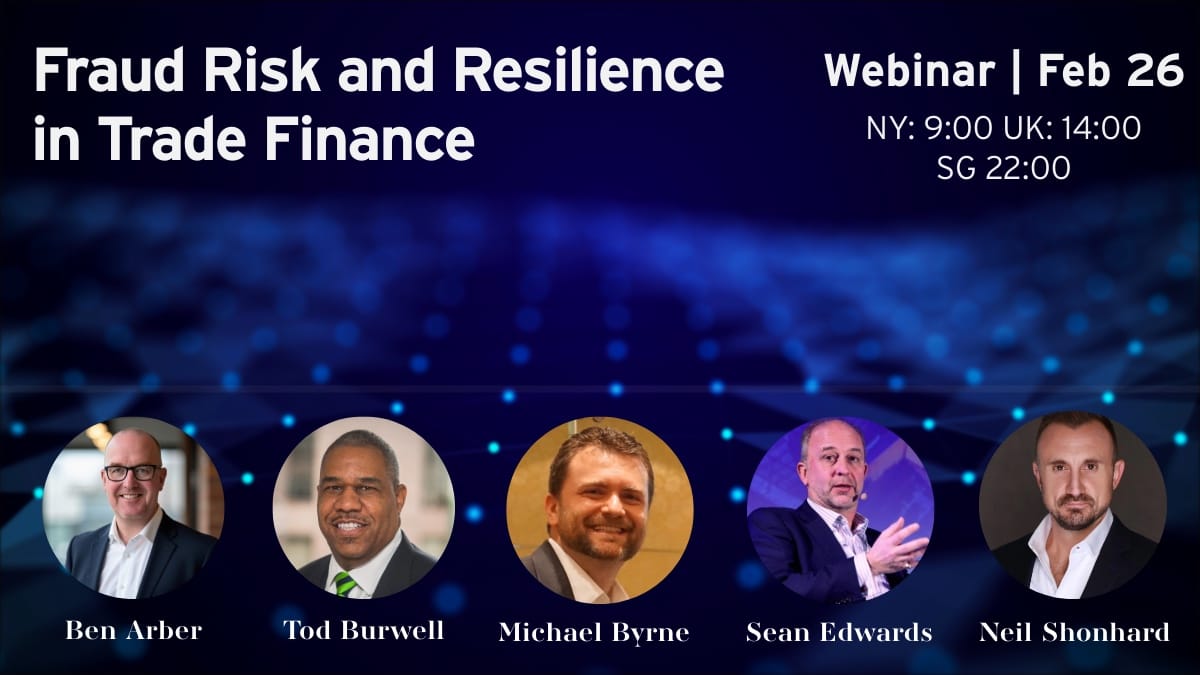
But first:
Fraud Risk & Resilience in Trade Finance
Free Webinar: February 26th
Recent high-profile trade fraud cases in the United States have once again exposed deep structural weaknesses in the global trade and supply-chain finance ecosystem. Warning signals are visible: duplicated documents, inconsistent data, and opaque cross-border processes, yet too often these red flags fail to trigger coordinated action.
Join ITFA, BAFT, and Institute of International Banking Law & Practice, hosted by Trade Treasury & Payments, for a practical, forward-looking discussion on problems, patterns, and solutions.
The seemingly simple word “assignable” can create real ambiguity in standby letters of credit and demand guarantees. This technical note unpacks how UCP 600, URDG 758, and ISP98 treat assignment of proceeds versus transfer of rights, why the distinction matters in practice, and why unclear drafting can expose issuers to unintended consequences—even where no payment is ever expected.
Price mis-invoicing remains a stubborn TBML and fraud risk, but “price verification” can mean very different things in practice. This ITFA paper maps the main approaches—manual review, targeted enhanced due diligence, corridor-level mirror analysis, thresholds, and emerging automation using AI/LLMs—while stressing the real constraints: data quality, false positives, governance, and the need for trade-skilled teams who can balance compliance effectiveness with client friction.
By Ed Stoltenberg and Byron McKinney
Ningbo Nanheng Import & Export Co., Ltd v. Shinhan Bank Corp. [2021]
A Chinese appellate court rejected an issuing bank’s fraud defense and ordered payment under seven letters of credit, despite inaccurate shipment dates on bills of lading. The decision examines surrendered B/Ls, good faith, and the limits of document-based defenses where banks knowingly structure delivery-before-payment arrangements, offering important lessons for LC practitioners.
By Saibo Jin
ABA Financial Crimes Enforcement Conference: Executive Summary
From electronic letters of credit and UCC Article 12 to sanctions, insolvency, and supply chain finance risk, this wide-ranging panel mapped the legal fault lines shaping modern trade finance. Relevant reading for those navigating how courts, regulators, and practice rules are redefining certainty in documentary instruments and related financing structures.
This month also marks the introduction of DCW Profiles, a new section spotlighting members of the DCW Editorial Advisory Board and the wider DCW community.
Our first Profiles feature Edward Stoltenberg, a DCW Editorial Advisory Board member and current Bank Examiner at the OCC, who also serves on ITFA committees and previously led trade and working capital solutions at Citi. We also feature Dennis Noah, a longtime IIBLP Associate and DCW Editorial Advisory Board member, whose career includes senior trade finance roles at M&T Bank and decades of experience across the evolution of letters of credit and rulemaking.
Thanks for reading. Is there a topic or issue you'd like to see tackled by the DCW Editorial board? Let us know.
Paid members have full access to expert case summaries, practical eBooks, editorial analysis, and CPD credit.
Email us to find the right subscription for you.
Gain full access to analysis, cases, eBooks and more with a DCW Free Trial