

DCW Monthly: September 2026
This month's content returns to a question the rules answer clearly and the courts sometimes do not: who
This month's content returns to a question the rules answer clearly and the courts sometimes do not: who

Talk of a trade’s digital transformation is in the air, but ICC UAE convened a focused stakeholder forum to

With the latest annual update to formats and rules on the Swift network approaching in November, Swift agreed to a
The ICC Banking Commission’s quarterly meeting, held via Zoom on 21 October 2025, discussed six draft opinions, the status of Technical Advisory Briefings, a call for comments on the future of UCP and ISBP, and the emergence of stablecoin as relates to ICC rules and digital trade law.

ICC Opinion TA952 involves two open-ended guarantees issued subject to URDG 458 (1992) and French law. Although the applicant indicated that the underlying obligations for the guarantees have been satisfied, the beneficiary “no longer exists” and therefore cannot affirm the obligations have been fulfilled. The Query asks a series of questions, including whether URDG 758 supersedes URDG 458, whether the guarantor can cancel the guarantees outright or based on beneficiary’s prolonged silence as evidence they no longer exist. Also, what proof, if any, the guarantor needs to furnish that the beneficiary no longer exists and whether the beneficiary would have any legal recourse to claim on the guarantees if they were cancelled.
The ICC Opinion’s Analysis first responded that a demand guarantee, unless properly amended, remains subject to the rules mentioned in that guarantee.
Although URDG 458 provides no specific guidance on termination procedures for open-ended guarantees, the Analysis quoted URDG 458 Article 23 wording which aligns with “international standard demand guarantee practice” which holds that open-ended guarantees “will remain in force unless the beneficiary provides a signed release from liability under the guarantee, or the original guarantee is returned to the guarantor for cancellation.”
Based on information contained in the Query, the Analysis stated that “the rights of the guarantor to cancel the guarantees depend more on French contract and commercial law” and therefore “suggested that a legal opinion be obtained”. The Draft Opinion had included additional analysis as to evidence considerations and action the guarantor might take, but these paragraphs were deleted to avoid the impression of giving legal advice regarding local law.
The Opinion first concluded that rule sets are separate and independent, so URDG 758 does not supersede URDG 458. On the Query’s other questions, the Opinion concluded that each is “a matter for determination under French law and, possibly, the law of Country L.”
In discussion, a suggestion was made to indicate that the wording "international standard demand guarantee practice" as it existed in relation to URDG 458 as the query itself relates to a guarantee subject to that rule set instead of URDG 758, under which the practice is different.
For status of recent Opinions see the ICC Opinions Tracker
ICC Opinion TA953 deals with a URDG 758 guarantee where the beneficiary made a demand for payment but did not indicate the claimed amount nor any payment instructions. The query asks whether the payment request is compliant and the guarantor is obligated to pay.
Although the URDG 758 Article 2 definition of “Demand” and URDG 758 Article 15 (Requirements for Demand) do not explicitly require that the claimed amount be indicated in the demand, the Opinion’s Analysis stated that “this is inherent to the very function of a demand” and “may be inferred from other rules in the URDG”. The Opinion also states that any demand must be made in accordance with “international standard demand guarantee practice” which requires that an amount be indicated in any demand for payment. It further quotes the conditions in ISDGP 814 paragraph 111 that a demand must satisfy in order to be complying, including that “indicate the amount claimed”. For these reasons, the Opinion concludes that the demand is non-complying and the guarantor was entitled to reject the demand in accordance with URDG 758 Article 24.
Based on National Committee written comments, wording was added to the Analysis to reinforce that “ISDGP is intended to supplement the rules, and should be read alongside the URDG.”
ICC Opinion TA954 deals with a UCP600-issued standby LC containing an auto-extension clause providing that the standby would be extended for periods of one year (initially on 24 December 2014) unless the issuing bank notified the beneficiary and applicant at least 120 days before the (then) current expiration date of its decision not to extend the standby. In August 2024, the issuing bank sent the required non-extension notices to the beneficiary and applicant. While the beneficiary received their notice on 26 August 2024 (120 days before the expiry date), the applicant received their notice on 28 August 2024 (118 days before the expiry date) but wanted to waive the delay in receiving the notice so that the standby would expire on 24 December 2024.
The Query asks whether the applicant may waive its notification period for the standby to be fully cancelled on 24 December 2024. The Query also inquires as to ways the standby’s auto-extension wording might be interpreted, whether the non-extension notices were ineffective, and if the outcome would be any different if the standby had been issued subject to URDG 758 or ISP98.
Noting that UCP 600 does not address credits that are the subject of an auto-extension clause, the Opinion’s Analysis said the clause itself is the basis for answering the Query. The Analysis also pointed out the term “notify” or “notified” is not defined in UCP 600. Based on the auto-extension clause and the signed return receipts, notification to the applicant was not timely and thereby had no effect. The Opinion interprets the term “notify” to mean that the recipient needs to receive that notice, i.e. notification happens on receipt of the message.
Since timely notices to both beneficiary and applicant were needed to invoke a final expiry date, the Analysis stated “it would not be sufficient for the applicant to “waive” its notification period, and no article exists in UCP 600 to support such practice.”
On the Query’s other questions, the Opinion concluded that the earliest expiry date would be 24 December 2025 and that the auto-extension clause’s wording “would permit a notification to be notified to the beneficiary and applicant at any time but at least 120 days prior to the then expiry date.” The Opinion also determined that the answer “would be the same had the standby been issued subject to URDG 758 or ISP98.”
The Technical Advisory Team noted that extensive written comments to the Draft Opinion were submitted by ICC National Committees, underscoring that TA.954 responds to an unusual, ambiguous, and poorly drafted standby clause.[[1]] The principal concerns identified included: “the undefined nature of ‘notify’ in ICC rules; the confusion between ‘dispatch’ and ‘receipt’; the need to correct typographical errors; and the importance of clarifying that the Opinion’s reasoning applies only to the specific wording in the query and does not alter general practice.”
In discussion, one NC representative suggested that although neither UCP600 nor ISBP defines the specific meaning of “notify” or “give notice”, there is a similar concept regarding giving notice of refusal to the presenter under UCP600 Article 16(d) which stipulates that a refusal notice must be given no later than the close of the fifth banking day. The representative also mentioned an explanation provided by Professor James Byrne in UCP600: An Analytical Commentary: “There is no explanation of 'given' but it is generally understood to be sent and not received”.[[2]] In this Query involving a standby subject to UCP600, this interpretive principle applied to notice of refusal will have a non-negligible bearing on the construction of the clause in question. Additionally, with this consideration in mind, it is more complicated and uncertain to apply the rule of contra proferentem for interpretation of the word “notify” in the clause. Therefore, the representative maintained that it was a legal question subject to local law and inappropriate for the ICC Banking Commission to answer such a specific legal question.
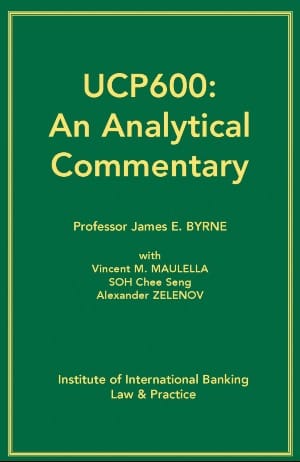
Exhaustive rule-by-rule handbook with analysis for sound drafting
ICC Opinion TA955 involves a collection subject to URC 522. A remitting bank sent a promissory note with an expiry date of 28 December 2023 to the collecting bank which was received 24 December 2023. Fifteen days after the promissory note expiry date, remitting bank inquired to the collecting bank as to the fate of the collection. Despite repeated requests, the collecting bank neither returned the promissory note as unpaid nor confirmed payment and gave evasive response that the debtor would have paid directly. The Query asks whether the collecting bank is obliged under URC 522 Article 26(c)(3) to pay or return the unpaid promissory note to the remitting bank.
The Opinion’s Analysis pointed out there is no indication that the collecting bank presented the promissory note to the drawee or acted in a manner that conforms with its duties under the collection instructions, so in the case of non-payment, the collecting bank must return the promissory note. The Opinion concluded that, presuming the remitting bank requested return of the promissory note, the collecting bank is required to return it without delay based on URC 522 Article 26(c)(3). However, “a collecting bank is under no obligation to pay a Promissory Note it did not sign, avalize or otherwise agree to pay.”
That last sentence elicited concern from many who were worried it may be interpreted that the collecting bank would not be liable to pay as consequence of its breach of URC 522, e.g. if it released the promissory note without payment or otherwise would not be able to return it. Wording to dispel such interpretation was discussed.
ICC Opinion TA956 deals with a UCP600 commercial LC under which a complying presentation was made to the issuing bank. Three weeks later, the presenter contacted the issuer for payment and that same day received the original documents back from the issuing bank with text wording to the effect that the documents were refused as they were non-compliant with “our internal compliance risk management”. The presenter responded by stating the return was not acceptable, the issuing bank violated UCP600, and went on to request immediate payment of the presented documents.
After receiving further communication from the issuing bank reinforcing its stance, presenter was informed the following day it should send the documents back to the issuing bank. Eventually presenter received payment. The query asks whether internal compliance risks are synonymous with sanctions, whether documents are deemed to have been accepted if not refused according to UCP600 Article 16(d), and whether, in spite of its delay, the issuing bank can reject re-presented documents.
The Opinion’s Analysis explained that internal compliance risks are not the same as sanctions in the context of UCP 600 and they do not automatically constitute grounds for refusing documents. Additionally, the Analysis emphasized “it is not acceptable for a bank to simply cite ‘internal compliance risks’ without reference to applicable legal instruments, regulatory rulings, or court orders.” The first presentation of documents was compliant and deemed accepted due to the issuing bank’s failure to refuse according to the requirements of UCP600 Article 16. As regards the issuing bank’s ability to reject the re-presented documents, it cannot. The Analysis stated: “When a presentation is, incorrectly, returned by the issuing bank, and is subsequently re-presented, then the issuing bank cannot refuse the presentation if it is returned in the same form and substance as the original presentation.”
ICC Opinion TA957 deals with a UCP600 commercial LC requiring “original clean (on board) marine/ocean bill(s) of lading”. Following presentation, issuing bank refused, citing ISBP821 Paragraphs E27(a) and (b) which prohibit indication of costs additional to freight, including trade terms such as “Free Out”. The Query asks whether the appearance of the pre-printed term “Free Out” on the presented B/L constitutes a valid discrepancy based on the cited ISBP821 paragraphs or whether such pre-printed wording is to be disregarded based on UCP600 Article 20(a)(v).
Citing UCP600 Article 20(a)(v) wording that “Contents of terms and conditions of carriage will not be examined”, the Opinion explained that the pre-printed words “Free out” are clearly part of the terms and conditions of carriage under the heading “Additional Clauses” and are not to be examined. As a result, the discrepancy is not valid.
Following discussion of the opinions, other topics were addressed in short order. Regarding the Status of Technical Advisory Briefings, a TAB on Surrendered Bills of Lading is currently being drafted and is projected for release in 2026. Two other TABs – on Force Majeure and Third Party Documents – are nearing completion.
The ICC Steering Committee has now launched two surveys to solicit views from ICC National Committees on the prospects of UCP and ISBP revisions. One survey is seeking to gauge whether there is a substantive need to initiate a revision of UCP600. The audience was reminded that there was serious consideration of a UCP600 revision in 2017, but it was determined there was no business case. To date, no specific use cases or substantive elements for revision have been clearly identified, but the ICC Steering Committee deems it appropriate to re-assess and “take the pulse” of National Committee members whether practical use cases, operational challenges, or specific UCP600 articles justify commencing revision of the rules.
The other survey is asking whether the remaining issues identified in the ongoing ISBP work justify immediate continuation of the revision process or whether it should be deferred until resolution of the issues covered by the ISBP Education Project. In the early stages of revising ISBP 821, there were over 100 issues. Presently, there are less than 30. Consequently, members will help determine if there is sufficient rationale to continue & complete the ISBP revision process or if it should be deferred in favour of implementing Education Project proposals which aim at augmenting availability of ISBP. Responses will be analyzed in-depth. Deadline for completing both surveys is 12 January 2026, but National Committees are urged to respond as soon as possible.
Mindful that a number of global financial institutions are currently piloting or developing stablecoin networks and positioning them as trusted alternatives to private cryptocurrencies, the ICC is now looking at how stablecoin adoption may fit within ICC rules (UCP, eUCP, URDG, URDTT) and digital trade legislation UK ETD Act, MLETR). A chart was shared with the audience which identifies the relevance of these rule sets and laws and stablecoin alignment, suggesting that stablecoin could be used as a means of payment. The ICC may produce a briefing paper on stablecoin alignment with ICC rules and is considering adding the topic as an agenda item for the next Banking Commission Meeting.
Dates for 2026-27 ICC Opinion Sessions and Banking Commission Meetings are to be determined [Update: ICC has since announced general scheduling of its next Technical Advisory Meeting (27 Jan 2026), Paris Technical Meeting (Mar/Apr 2026), and London Plenary Meeting (Nov 2026).]
[[1]]: A strikingly similar problematic clause was taken up as a learning example in the 2019 BAFT Guidance Paper for Auto Extensions, accessible from BAFT on request
[[2]]: Byrne, Maulella, Soh, & Zelenov, UCP600: An Analytical Commentary (IIBLP 2010), p. 750

Talk of a trade’s digital transformation is in the air, but ICC UAE convened a focused stakeholder forum to

An LC's independence from the underlying transaction it supports is one of the core tenets that distinguishes this instrument type from other promises. When disputes arise, courts at times have given uneven treatment to independent undertakings with regard to the independence principle.

At its quarterly meeting on 21 July 2026, the ICC Banking Commission reviewed and finalized six Opinions, including four dealing
Beyond discussion and finalization of six ICC Opinions at its quarterly Technical Advisory Session on 21 July 2026, the ICC
Gain full access to analysis, cases, eBooks and more with a DCW Free Trial